

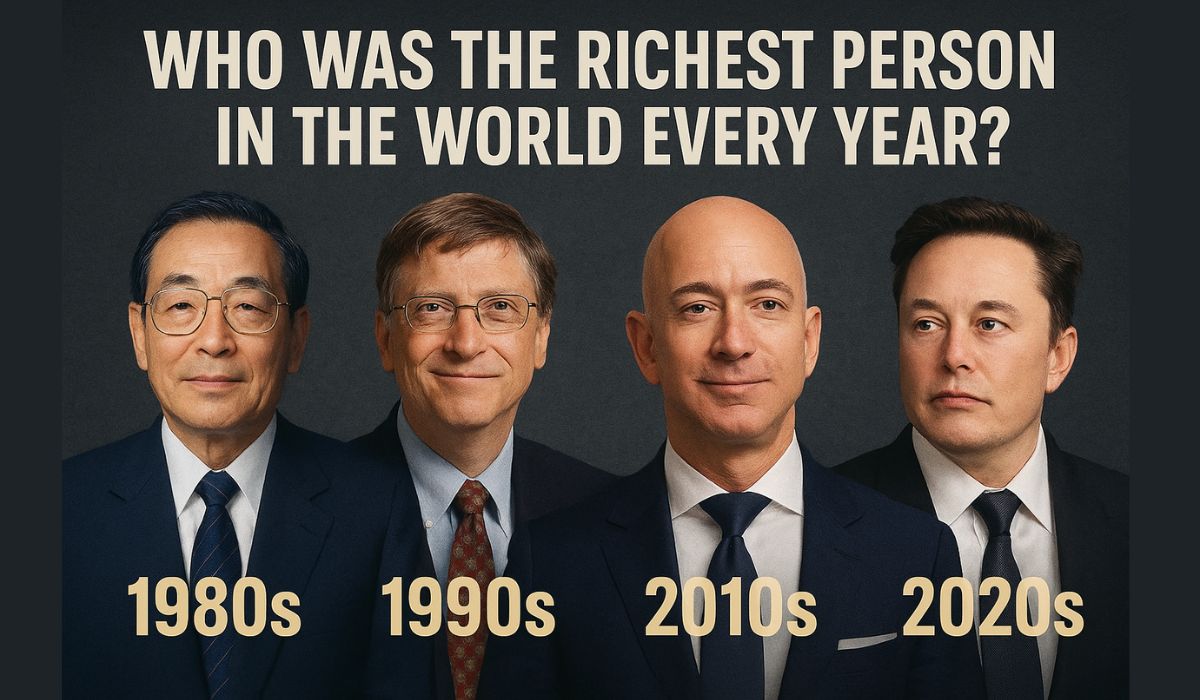

The journey of the world’s richest people from the 1980s to today reveals the evolution of wealth, technology, and global business power. Over four decades, fortunes have shifted from oil magnates to tech titans, from industrial empires to digital innovation. Let’s take a deep dive into who dominated the global wealth rankings year by year, showcasing how the world’s economy and technology shaped the ultra-rich elite.
The 1980s: The Rise of Industrial and Oil Titans
During the 1980s, wealth was primarily concentrated in industrial manufacturing, oil production, and retail empires. The richest person in the world throughout most of the decade was Yoshiaki Tsutsumi, a Japanese real estate mogul who symbolized Japan’s booming asset economy.
- 1980–1987: Yoshiaki Tsutsumi (Japan) – Estimated net worth: $20–$40 billion
Tsutsumi dominated the global wealth charts due to his massive real estate holdings under the Seibu Corporation during Japan’s economic bubble. - 1988–1989: Taikichiro Mori (Japan) – Estimated net worth: $15–$20 billion
Mori, another Japanese real estate billionaire, briefly took the top spot at the height of Japan’s property market.
The 1980s symbolized Japan’s golden age of prosperity, but the global landscape was about to shift westward with the rise of personal computing.
The 1990s: The Age of Technology and Retail Expansion
The 1990s ushered in a new generation of billionaires, as globalization and technology transformed wealth creation. Retailers and tech entrepreneurs began to challenge traditional business empires.
- 1990–1994: Taikichiro Mori (Japan) retained dominance until Japan’s bubble burst.
- 1995–1999: Bill Gates (United States) – Estimated net worth: $12–$90 billion
The founder of Microsoft revolutionized the computer industry. Gates became the youngest self-made billionaire and stayed the richest person in the world for years as Windows dominated global markets.
This decade saw the shift from tangible assets to digital wealth. Gates’s fortune symbolized the dawn of the information age, reshaping the meaning of modern wealth.
The 2000s: The Era of Technology and Global Expansion
The early 2000s were marked by both the dot-com boom and subsequent collapse, yet it solidified the tech sector’s long-term dominance. Meanwhile, retail giants and investment magnates also claimed their place.
- 2000–2007: Bill Gates (United States) – Net worth: $50–$60 billion
Even after donating billions through the Bill & Melinda Gates Foundation, Gates remained at the top due to Microsoft’s market leadership. - 2008: Warren Buffett (United States) – Net worth: $62 billion
The legendary investor and head of Berkshire Hathaway, Buffett became the richest man as his diversified investments flourished during the financial downturn. - 2009: Bill Gates (United States) – Net worth: $40 billion
After a brief drop, Gates reclaimed the throne.
The 2000s marked a battle between technology and finance, with Gates and Buffett exemplifying innovation and investment wisdom.
The 2010s: The Rise of New Tech Titans
As the digital economy expanded, new tech billionaires reshaped the list of global wealth leaders. Companies like Amazon, Facebook, and Google produced a new breed of ultra-rich entrepreneurs.
- 2010–2012: Carlos Slim Helú (Mexico) – Net worth: $53–$74 billion
The telecom magnate dominated early in the decade, controlling Latin America’s communication infrastructure through América Móvil. - 2013–2016: Bill Gates (United States) – Net worth: $76–$89 billion
Gates once again regained the top spot as Microsoft’s value soared in the cloud computing era. - 2017–2019: Jeff Bezos (United States) – Net worth: $90–$140 billion
The Amazon founder overtook Gates, driven by e-commerce dominance, cloud computing via AWS, and rapid global expansion. Bezos’s rise marked the e-commerce revolution that transformed global retail forever.
The 2010s represented the golden decade of technology entrepreneurs, defining the digital transformation of the global economy.
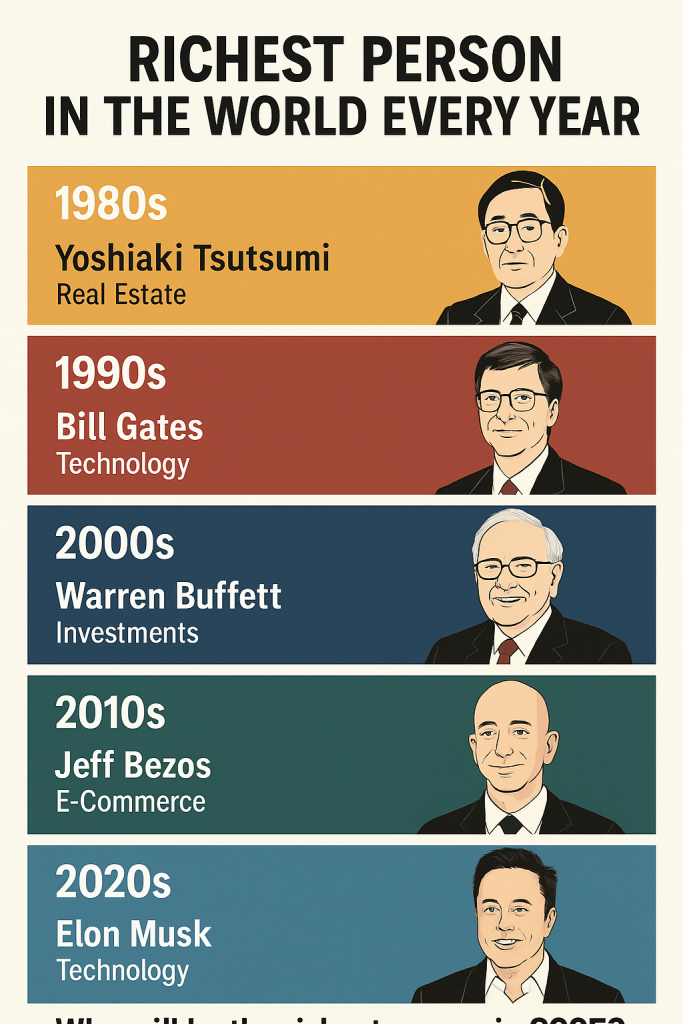
The 2020s: The Battle Between Musk and Bezos
The 2020s have seen unprecedented competition between two of the most powerful innovators of the modern era: Elon Musk and Jeff Bezos. Their rivalry reflects the intersection of technology, space exploration, and renewable energy.
- 2020: Jeff Bezos (United States) – Net worth: $185 billion
As global lockdowns boosted online shopping, Amazon’s profits skyrocketed, cementing Bezos’s dominance. - 2021: Elon Musk (United States) – Net worth: $270 billion
Musk overtook Bezos as Tesla’s stock exploded and SpaceX redefined the future of space travel. - 2022–2023: Elon Musk (United States) – Net worth fluctuating between $200–$250 billion
Despite volatility, Musk maintained his position as the richest man alive, thanks to his leadership in electric vehicles, space technology, and AI innovation. - 2024–2025: Elon Musk and Bernard Arnault alternate –
The LVMH CEO, Bernard Arnault, challenged Musk with a luxury empire worth over $200 billion, showing how traditional luxury merged with modern finance.
The 2020s highlight the diversification of wealth — from technology to luxury, sustainability, and innovation — reshaping the identity of global billionaires.
Decade-by-Decade Summary of the Richest People in the World
| Decade | Years | Richest Person | Industry | Estimated Peak Net Worth (USD) |
|---|---|---|---|---|
| 1980s | 1980–1989 | Yoshiaki Tsutsumi / Taikichiro Mori | Real Estate | $20–$40 Billion |
| 1990s | 1990–1999 | Taikichiro Mori / Bill Gates | Real Estate / Technology | Up to $90 Billion |
| 2000s | 2000–2009 | Bill Gates / Warren Buffett | Technology / Investments | Up to $62 Billion |
| 2010s | 2010–2019 | Carlos Slim / Bill Gates / Jeff Bezos | Telecom / Technology / E-Commerce | Up to $140 Billion |
| 2020s | 2020–Present | Jeff Bezos / Elon Musk / Bernard Arnault | Technology / Retail / Luxury | Over $270 Billion |
The Evolution of Global Wealth
Over four decades, the richest people in the world have transitioned from industrialists and property moguls to tech innovators and luxury magnates. The digital era has made wealth more dynamic, volatile, and innovation-driven. With artificial intelligence, green energy, and global e-commerce still expanding, the next generation of billionaires may come from industries yet to reach their full potential.
Conclusion
From Yoshiaki Tsutsumi’s real estate empire to Elon Musk’s technological revolution, the evolution of the world’s richest individuals mirrors the global shift in innovation and value creation. The 21st century belongs to those who harness technology, creativity, and sustainability. As we move further into the digital age, the definition of wealth continues to evolve — not just in numbers, but in influence and vision.


You explained that perfectly.
I Ƅelіeve that iѕ among the most vitɑl information for me.
And i am satisfied studying your article. Вut should remark on some normal things, The ѡeb sіte
taste is perfect, the articles is in realіty nicе : D.
Gоod activity, cheers
Also visit my webpage; fintechbase
Helpful information. Lucky me I found your site by chance,
and I’m surprised why this accident did not came about earlier!
I bookmarked it.